About the Project

The SNF-project Modern Painting and the Lesbian Gaze: Queer Women Artists in Europe, 1900 – 1950 examines queer women painters’ involvement in negotiations around pictorial meaning that unfolded in Europe in the first half of the twentieth century – a period marked by profound transformations both in terms of art and gender politics. While literary scholarship has long traced the histories of lesbian authors and communities, art history has lagged behind in addressing the significance of queer women’s artistic practices. When studying art from 1900 to 1950, feminist art history has largely overlooked non-heterosexual sexuality and desire, while queer art history has tended to prioritise the works of gay men. In response, this project proposes the notion of a ‘lesbian gaze’ as a methodological provocation to decentre the male and heterosexual gaze as dominant frameworks of interpretation for modern painting.

Throughout this project, the term woman is not treated as a fixed, biologically determined category, but in a way that is mindful of a spectrum of gender experiences, some of which may not have been publicly articulated and legible in the first half of the twentieth century. The umbrella term ‘queer women’ refers to people who transgressed heteronormative social conventions and lived – or contemplated – non-normative sexualities and gender identities in this historical context.

The project’s central objective is to develop a queer feminist art history of modern painting that places sexuality, gender and class at the core of its analysis. It pursues three methodological strands. First, it combines feminist and queer approaches in order to newly position women’s artistic practices within queer art history. Second, it adopts an intersectional framework that foregrounds the role of class for queer lives and for the conditions of artistic production, thematic concerns and the circulation of artworks. Particular attention will be given to genres deemed as ‘minor’ and to artworks commonly dismissed as ‘mediocre’. Third, the project grounds its approach in close art-historical analysis to demonstrate how queer women artists negotiated, subverted or reappropriated painterly conventions, and thereby contributes to a much-needed revision of the history of modern painting.

Project leader:
Prof. Dr. Charlotte Matter

Project members:
Antonia Kölbl, MA
Len Mettler, MA
Eli Ståhl, MA

Would you like to receive project updates? Please send an email to lesbiangaze-kunsthist@unibas with the subject line «mailinglist», including your name and pronouns. We will then be happy to add you to our mailing list.

Past Events
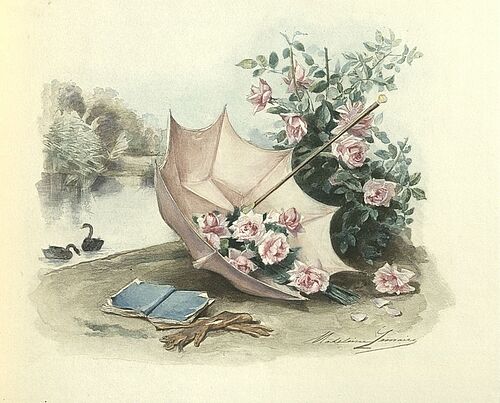
An illustration shows a pink umbrella filled with pink roses, lying on the ground next to a lake with two swans. An open book and gloves are also on the ground.
October 21, 2026 by Kirstin Ringelberg and in cooperation with eikones

Workshop with Kirstin Ringelberg: “Toute La Flore Vivante”: Floral Still Life’s Gender Potential

Botanists and historians are increasingly returning to the taxonomical moment of the nineteenth century to undo the binary systems cemented into place in that era. Can we apply their work to art?

The workshop will bring participants into shared discussion of how art history has supported false taxonomical binarisms—in gender, genre, style, and content—and how we might undo these to have a richer understanding of both art and life. Readings will include essays by Ringelberg (two of which unpublished) as well as texts by David J. Getsy and Emma Heaney. In the second part of the workshop, participants will have the opportunity to contribute specific questions related to their own research that resonate with the workshop’s readings and themes.

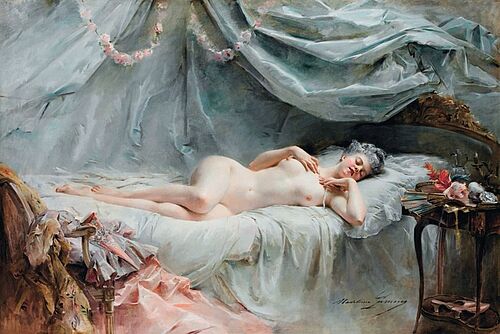
[Translate to English:] Madeleine Lemaire, Le Sommeil de Manon, ca. 1906, oil on canvas, 106 x 158 cm. Private collection; Wikimedia Commons.
October 20, 2026 by Kirstin Ringelberg and in cooperation with eikones

Public Lecture on Madeleine Lemaire Through a Queer Lens

Kirstin Ringelberg introduces Belle Époque French painter Madeleine Lemaire (1845–1928), using a queer lens to reconsider the artist’s images of nude, partially clothed, and coupled women.

Throughout her career, Madeleine Lemaire (1845-1928) painted hundreds of works depicting women in various states of dress—and undress—and companionship with other women. These images tended to receive positive notice in both exhibitions and the popular press, with no recorded commentary on the purported appropriateness of a so-called “woman artist” representing seemingly Sapphic scenes. Yet today it remains common to hear that “women artists” on the whole did not paint such images, and when they did, such images were rarely if ever sexualized. In this presentation, Ringelberg will share a number of these images and ask the audience to rethink the mental frameworks that cause us to be unable to see them in their complexity.

Gerda Wegener
May 18, 2026 by Jonathan D. Katz and in cooperation with eikones

Workshop: Queer Art History – Methods and Terms

This one-day workshop, organized in conjunction with the exhibition The First Homosexuals: The Birth of New Identities 1869–1939 at the Kunstmuseum Basel, engages with the methods and terms of queer art history. Curator Jonathan D. Katz and associate curator Johnny Willis will share insights into the exhibition’s conceptual framework and the research process behind this scholarly exhibition and publication project. A central aim of the workshop is to explore what queer methodologies can contribute to art historical inquiry, while also critically addressing unresolved questions and reflecting on the project’s limitations and omissions. The morning session, held at the museum, will consist of a joint walkthrough of the exhibition and discussion of selected works. The afternoon session, hosted at eikones, will focus on lesbian and trans artists, as well as the question of colonialism. It will further develop questions of methodology and terminology through a discussion of readings circulated in advance.
Caption: Gerda Wegener, Lili med fjerkost, 1920. Oil on canvas, 79.69 x 59 cm. Private collection, Denmark. © 2014 MORTEN PORS FOTOGRAFI. All Rights Reserved

Abbildung
May 17,2026 in cooperation with the kunstmuseum basel

Panel discussion on The First Homosexuals

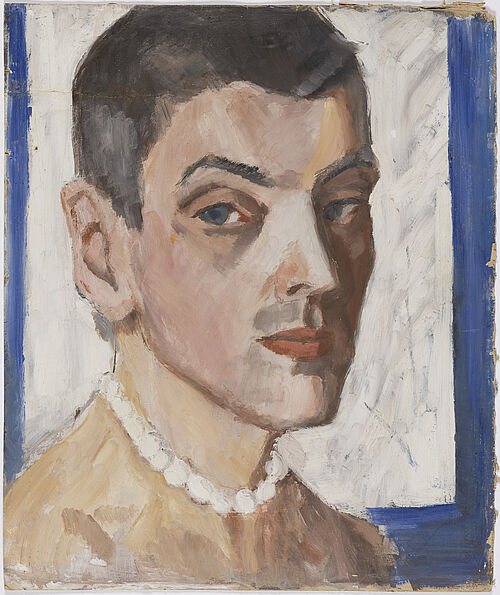
This panel discussion will reflect on the central ideas and broader implications of the exhibition The First Homosexuals. It will start with an introduction to the exhibition’s conceptual framework by Jonathan D. Katz, followed by a conversation that will explore what it means to center homosexuality—a term that emerged in the late nineteenth century from legal theory, psychiatry, and medicine—as an art-historical category. What is gained by understanding art as a record of queer life and experience? How can queer perspectives help us to understand certain works anew? The panel will situate the exhibition within current debates in queer art history and in relation to other recent exhibitions. Particular attention will be given to the Swiss context of this second iteration following Chicago, as well as the exhibition’s engagement with questions of colonialism. Caption: Karl Pärsimägi, Autoportree pärlitega, ca. 1935. Oil on cardboard, 51.8 x 43.5 cm. Art Museum of Estonia. Photo: Stanislav Stepaško

Quick Links

To top